

ALBAWABA- Yemen’s newly formed government, the sixth to operate from exile in just over a decade, was sworn in on Monday at the Yemeni embassy in Saudi Arabia, underscoring both a political reset and the deepening crisis of legitimacy facing the internationally recognized authorities.
The new cabinet, led by Prime Minister Shaia’a al-Zandani, is the largest in Yemen’s modern history, comprising 35 ministers drawn from a range of anti-Houthi factions broadly aligned with Saudi Arabia.
While presented as inclusive, the lineup excludes representation from Hajjah, Al-Mahweet, and Al-Jaouf governorates, highlighting persistent regional gaps in a country fragmented by war. Al-Zandani will simultaneously serve as prime minister, foreign minister, and Yemen’s ambassador to Saudi Arabia, further concentrating authority within a Riyadh-centered power structure.
This marks the sixth government to be formed in exile since the Saudi-led intervention began in 2015. That year saw the first cabinet under Khaled Bahah, followed by Ahmed Obaid bin Dagher’s government in 2017. Two successive cabinets were later formed by Maeen Abdulmalik between 2019 and 2022 under former president Abd Rabbu Mansour Hadi.
Ahmed Awad bin Mubarak led the government from 2022 to 2025, succeeded briefly by Salim Saleh bin Buraik, before the latest reshuffle produced al-Zandani’s cabinet.
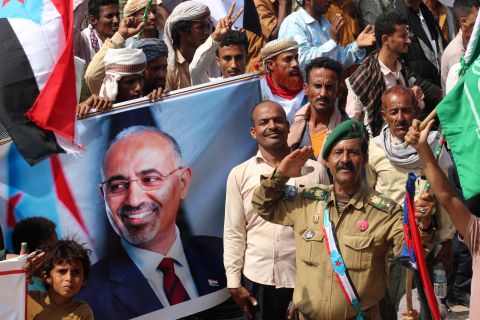
The swearing-in, conducted before Presidential Leadership Council chairman Rashad al-Alimi, comes amid a broader Saudi-led reordering of the Yemeni file. It follows weeks of tension between Saudi Arabia and the United Arab Emirates in Hadramout, including reported Saudi pressure that led to a reduction of Emirati backing for the Southern Transitional Council. This was followed by the UAE’s partial military withdrawal, the dismissal of Aidrous al-Zubaidi and Faraj al-Bahsani from the presidential council, and the creation of Saudi-backed “Home Shield Forces” to replace STC-aligned units in eastern and southern Yemen.
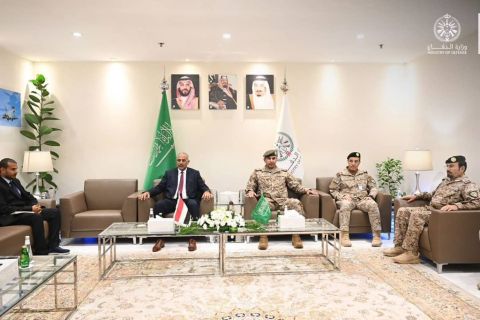
While officials framed the new government as a step toward revitalizing the anti-Houthi camp, its formation under direct Saudi supervision has reinforced perceptions of external control. Internal divisions persist among the cabinet’s constituent factions, united primarily by Saudi sponsorship and opposition to the Houthis rather than a coherent national program.
Notably, the cabinet includes three women for the first time since 2019, a symbolic shift welcomed by some observers. Yet the broader optics remain troubling. After 11 years in exile, the government continues to operate without effective authority on the ground or parliamentary validation, relying instead on international recognition.
The repeated formation of governments abroad highlights the failure of the Saudi-led coalition’s stated objective of restoring legitimacy and ending Houthi rule. Instead, years of war and mismanagement have entrenched Houthi control in the north, devastated Yemen’s infrastructure, and prolonged civilian suffering, while the internationally recognized government remains confined to exile, reshuffled but largely powerless.