Prioritising refugees over low-income Jordanians negatively impacts social cohesion in Jordanian society, fuelling feelings of marginalisation and furthering economic frustration in areas of the country, such as Mafraq, where impoverished Jordanians and Syrian refugees live side by side—a city hosting one of the biggest communities of Syrians in Jordan.

Mafraq, Jordan. (shutterstock)
Last year Jordan topped the list of Arab recipients of international aid in (2016). Despite this, the influx of refugees into the country has undoubtedly placed economic pressure on the country, hitting the poorest in Jordanian society hardest.
Part of the research conducted by the West Asia-North Africa Institute (WANA) identifies the prioritisation of refugees over low-income Jordanians within aid and development programming as a key driver in radicalisation, particularly among youth, a demographic more vulnerable to indoctrination.
Although a largely safe and stable country, in recent years extremism and radicalization has been a prominent issue in Jordan. It has been estimated that, since the start of the Syrian conflict in 2011, over 30,000 foreign fighters have joined the ‘Islamic State’ or ‘Daesh’ (the arabic acronym for the group). The Middle East is, due to proximity and access, the biggest contributor to this figure, with over 11,000 foreign fighters originating from the region. According to 2017 estimates, Jordanian foreign fighters make up its largest or second largest proportion on a per capita basis, with over 3000 soldiers. The reasons for why this is happening are a complex mix of economic and governance challenges, the large influx of refugees into the country and undoubtedly ideological issues such as the increasing regional acceptance of suicide bombing as a path to ‘martyrdom.’
Many studies have been done on the drivers of radicalisation in the region, but one aspect of the equation which is less understood is the relationship between human security programming and the drivers of radicalisation.
At a conference held this week, the West Asia-North Africa (WANA) Institutegathered 25 experts in order to discuss the relationship between human security programming and countering violent extremism in Jordan.
Youth as a largely ignored demographic
The research found that youth in Jordan is a relatively ignored demographic. The 10-16 age group is particularly affected, its members exhibiting growing resentment towards authorities, and are thus more likely to engage in deviant behaviour.
Within the context of tensions between Syrians and Jordanians, there is a particularly large program gap amongst youth. Syrian youth have the opportunity to advance from various educational and social support programs on offer from international organisations, whereas Jordanian youth in the same socio-economic situation will not qualify for the same programs.
The resentment and marginalisation felt from this, coupled with a lack of opportunity and economic pressure, will undoubtedly affect vulnerable young people greatly.
Hebattal Taha, researcher associate at the International Institute for Strategic Studies in the Middle East, stated at the conference that within the literature on terrorism, the decision to carry out an act of violence is still understood to be purely political, and not as a result of ‘idleness’ or unemployment.
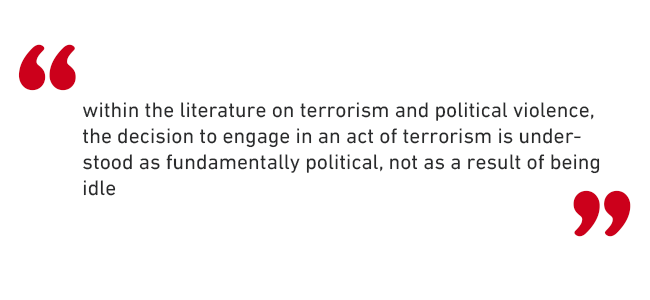
However, she goes on to say that “our understanding of what is and isn’t ‘political’ is not as clear cut anymore.” She asks a question: “Can we really distinguish the ‘political’ from the ‘non-political’? Is poverty, especially when it’s enmeshed with socioeconomic, gender and other forms of discrimination, not a political problem? In other words, if someone perceives their marginalization from society as being part of an institutionalized discrimination against a specific community, then ‘poverty’ cannot be discounted as a non-political cause. It becomes part of a perception of state violence.”
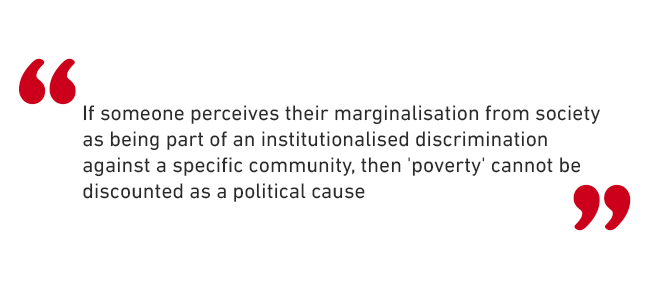
We see a direct example of this in the example of Europeans who join the Islamic State.
Marginalised, disillusioned youth living in communities suffering from social unrest are bound to become vulnerable to dangerous situations which lead them to destructive paths, whether extremism or otherwise.
Suggestions and solutions
In regards to social cohesion, the suggestion is for international organisations and donors of development programs to reduce their stipulations on local actors, whereby locals can also benefit from the same programs.
Building networks and relationships of solidarity between different marginalized communities is also a positive way forward. Hebattal Taha suggests using a successful model of programs in the north of Lebanon for Syrian and Palestinian refugees alike.
A possible problem with this, she suggests, is that donors in the NGO world place too much emphasis on seeing ‘impact,’ which is difficult to measure in terms of building networks and solidarity. Simply bringing people together to discuss relevant, pressing issues, or just getting to know each other is not seen as an ‘objective’ in of itself.
These seemingly minor but restricting aspects of international aid procedure are in need of reassessment in order for to move forward in countering violent extremism in Jordan and beyond.
The problem does not lie solely with International Aid Organisations however, the media has a big role to play in placing greater importance on specific marginalized societies over others. Only yeterday, Amal and George Clooney announced that they would open schools for Syrian refugees in Lebanon. These schools will be exclusively open to children of Syrian nationality, thereby marginalising underpriviledged Lebanese children who would benefit from them greatly.
From the West Asia - North Africa Institute (WANA)