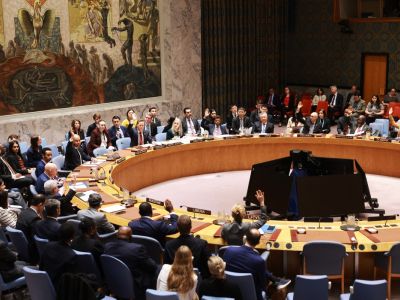
Embarrassed, the United States and Britain found themselves last week being forced to shelve their “smart sanctions” plan for Iraq, after it became evident that Russia would veto the proposal. As a result, the UN Security Council voted on July 3 to extend the existing Iraqi "oil-for-food" program for another 150 days, meaning that in less than five months the entire debate will be replayed once again.
The defeat of the US and British proposal appears to pave the way for a suspension of Baghdad’s self-imposed oil embargo, something that was hinted to by the country’s oil minister. As a result, the Organization of Petroleum Exporting Countries (OPEC) decided to keep total oil production at the current level of 24.2 million barrels per day.
Meeting in Vienna, representatives of OPEC’s 10 member nations, which include Iraq, also said that if a resumption of Iraqi exports causes a rise in world oil prices above the group's $22-28 per barrel target range, it would hold a special meeting to consider a reduction of production quotas.
The “oil-for-food” program allows Iraq to sell oil, and use about 60 percent of the revenues from the sale to buy food, medicine and medical supplies, as well as other items essential for maintaining the country’s civilian population. Oil is exported via UN-authorized outlets at Ceyhan in Turkey and the Mina Al-Baqr terminal in the northern Gulf.
Iraq had halted its oil exports on June 4 in protest over the “smart sanctions” proposal. As a result, according to estimates submitted by the United Nations, the “oil-for-food program” lost $1.3 billion over a four-week period.
According to the “smart sanctions” plan, the only goods to be embargoed would have been those items to which UN Security Council would have agreed that Iraq should have no access to. At the same time, free trade would be allowed in all other areas. On paper, this program represented a complete turnabout in approach. No longer would the Iraqis be told what they could import. Instead they would be told what they couldn’t import.
Writing in Al-Sharq Al-Awsat on June 21, Ben Bradshaw, the British Foreign Office undersecretary tried to present the “smart sanctions” as a humane alternative. “The new arrangements for civilian trade would mean no sanctions on ordinary imports into Iraq, only controls on military and weapons-related goods,” Bradshaw stated.
“Iraq would be free to meet all its civilian needs. This is not a deception, as Baghdad has claimed, but the unanimous aim of the Security Council. Of course, it suits the regime to maintain that UN controls cause suffering. But the truth is that, under the UN ‘oil for food’ program, Iraq has had billions of dollars in recent years to spend on food, medicines, health and educational goods and spare parts for its oil industry. The new arrangements would expand such trade and remove Baghdad’s excuses for claiming that controls are to blame for suffering.”
“[T]he international community has recognized the threat posed by Iraq’s weapons, which have inflicted great suffering on the Iraqi people and their neighbors,” Bradshaw continued. “But the international community has also resolved to remove any ground for suspicion that controls cause suffering. The controls on Iraq’s weapons would therefore be more focused; concentrating on a list of military and weapons-related goods whose export to Iraq would be subject to review. This more focused approach would make the controls easier to implement and more effective.”
So why is it that Iraq was so firmly against the replacement of the one UN embargo plan with a newer, “kinder” version?
For one, Baghdad is firmly opposed to sanctions, and is lobbying strongly to have them removed. It felt that acquiescing to a different form of sanctions was tantamount to agreeing to the concept of sanctions in the first place.
But it also is a case of the devil you know. For while the Iraqis despise the humiliation of the oil-for-food program, they have come to live with it relatively well. Considerable amounts of oil are being sold outside of the program, and officials in Baghdad are reportedly getting generous kickbacks from middlemen and oil firms.
But the United States and Britain may live to fight another day. Whereas, this time round, they were unable to convince the Russians to sign onto their new sanctions program, they were able to twist the arms of both the French and Chinese, both of whom also wield veto power in the Security Council. If for any reason a means becomes available to “persuade” Russia as to why their cause should be supported, Iraq’s current victory may be short-lived. ― (MENA Report)
© 2001 Mena Report (www.menareport.com)