



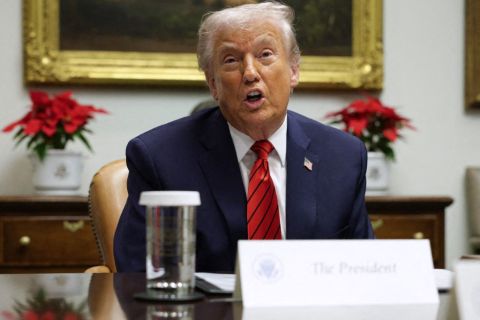
ALBAWABA- The United States seized a massive Venezuelan-linked supertanker off the country’s Caribbean coast on December 10, President Donald Trump announced at the White House, calling the Skipper “the largest tanker ever seized.”
U.S. forces, including the Coast Guard, FBI, and Homeland Security, executed a federal warrant targeting sanctioned crude tied to Venezuela and Iran.
Attorney General Pam Bondi released footage showing agents rappelling from helicopters onto the vessel, marking the first U.S. seizure of a Venezuelan oil cargo since sanctions began in 2019. The tanker had allegedly falsified its location data to evade detection and now faces possible forfeiture, with more than 30 other sanctioned ships at risk of similar action.
Venezuela swiftly condemned the operation. Its Foreign Ministry denounced the seizure as “blatant theft” and “international piracy” motivated by U.S. designs on the country’s natural resources.
President Nicolás Maduro echoed the accusation and urged Venezuelans to join local resistance to resist what he called “imperial abuses,” while Interior Minister Diosdado Cabello labeled the U.S. “pirates” and “high-seas criminals.”
The diplomatic fallout widened on December 11 when Russian President Vladimir Putin phoned Maduro to express Moscow’s “unwavering support” against “external pressure.” The Kremlin said the two leaders discussed strengthening their strategic partnership, including joint economic and energy projects, reaffirming Russia’s role as Caracas’s chief geopolitical ally.
The tanker seizure comes amid Washington’s revived “maximum pressure” strategy in Trump’s second term, framed as a campaign against Venezuelan “narco-terrorist” networks such as Tren de Aragua and the Cartel de los Soles.
Since August 2025, the U.S. has deployed thousands of troops and warships to the Caribbean and conducted 23 airstrikes on suspected drug-smuggling vessels, killing at least 87 people, actions that have drawn scrutiny from the UN and members of Congress over legality and civilian impact.
While Caracas dismisses the operations as a pretext for regime change and resource exploitation, the U.S. insists they target an “imminent threat” from cocaine trafficking. Regional unease is growing, with allies like the UK and Colombia pausing intelligence cooperation and Trump hinting at potential land operations, raising fears of a broader conflict in Latin America.


