


ALBAWABA- U.S. President Donald Trump’s trip to the World Economic Forum (WEF) in Davos was briefly disrupted on Tuesday night when Air Force One abruptly turned around mid-flight and returned to Washington, an incident that unfolded against a backdrop of intensifying transatlantic tensions over Greenland and accusations of U.S. imperialism.
White House officials confirmed that the Boeing 747 carrying Trump departed Joint Base Andrews around 9:40 p.m. ET but reversed course shortly after takeoff due to a minor electrical issue.
Press Secretary Karoline Leavitt said the aircraft returned “out of an abundance of caution,” stressing that no emergency was declared and all passengers remained safe. The plane landed back at Andrews at 11:07 p.m. ET, with reporters on board noting brief flickering lights in the press cabin.
Trump later resumed his journey aboard a backup aircraft, an Air Force C-32, departing shortly after midnight and remaining on schedule to arrive in Davos for planned engagements, including a possible sideline meeting with NATO Secretary-General Mark Rutte.
The incident came as Trump’s presence loomed large over Davos discussions, dominated by mounting friction between the United States and Europe.
Washington’s renewed push to acquire Greenland, a Danish autonomous territory, has drawn sharp rebukes from European leaders, particularly after Trump threatened punitive tariffs, reportedly as high as 200% on France, if countries continue backing Denmark’s sovereignty. The move has fueled claims of American “imperialism” and strained relations within NATO.
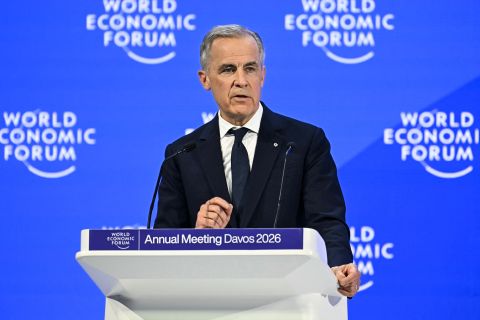
Speaking in Davos, Canadian Prime Minister Mark Carney described the moment as a global “rupture, not a transition,” arguing that U.S. hegemony no longer guarantees collective security or economic stability.
Carney reaffirmed Canada’s support for Greenland and Denmark, pledged stronger Arctic defenses, and underscored Ottawa’s commitment to NATO’s Article 5, while criticizing the weaponization of tariffs.
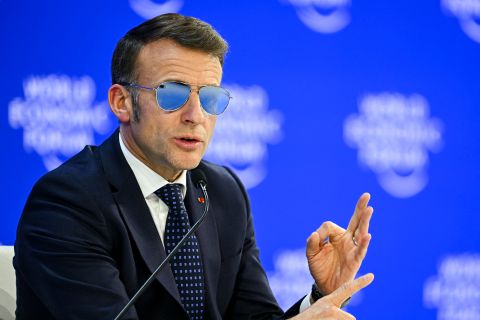
French President Emmanuel Macron echoed the criticism, warning of a “world without rules” marked by resurging imperial ambitions. Rejecting what he called “new colonialism,” Macron urged Europe to pursue strategic autonomy and multipolarity to counter coercive pressure from major powers.
While the aircraft glitch was quickly resolved, the episode symbolized the volatility in U.S.–Europe relations, with Trump’s Davos appearance expected to test already strained alliances as disputes over Greenland, NATO, and Ukraine continue to escalate.