The GCC stocks witnessed mixed trends in the first month of the new year. Market heavyweight Saudi Arabia continued to surge as it reported a monthly gain of 12.5% in Jan-06. Oman and Bahrain markets followed with monthly gains of 11.7% and 6.5% respectively. On the other hand UAE and Qatar market saw some selling activity in the month.
Global believes that the short term direction of the markets will be dictated by the earnings announcements and the upcoming IPOs as they will suck out liquidity from the market. Investor confidence about the corporate earnings seems to be strong and the early indicators of the net profits posted by the corporates/banks are quite encouraging. Investor friendly regulation such as reducing the par value of the stock by Oman stock market regulator are welcome as it will increase liquidity and retail participation in the market.
Ras Al Khaimah – Emerging as a favorable investment destination
Ras Al Khaimah (RAK), the fourth largest among the seven emirates that constitute the UAE, had a GDP of AED7.83bn in 2004, having grown by 12.6% over the previous year. RAK is dominated by the services sector which accounts for 60% of its Gross Domestic Product (GDP). The other major sectors include agriculture, livestock and fisheries which account for 17% with manufacturing contributing 8% and building and construction 9%.
The emirate had a population of 0.2 million in 2004, with an annual population growth rate of 5.1%. Inflation was low, with the average annual growth in Consumer Price Index during 1999–2002 being 2%.
The emirate also has thriving international trade with a host of countries within and outside the GCC region. Major exports from RAK include ceramic tiles, medicines, cement, crushed rocks, and fresh fish. Imports include clinker, live sheep, cars and gold. The main export destinations are Saudi Arabia, Bahrain, Kuwait, Qatar and Oman, while the emirate’s imports come from Iran, Oman, India, Japan, Bulgaria, Italy, Egypt, the United Kingdom, Australia and Greece. For 2004, RAK’s exports amounted to AED0.61bn, whereas imports were at AED5.75bn, leading to a trade deficit of AED5.14bn.
RAK is also a major re-exporter in the region. Re-exports, comprising of machinery & sound recorders, mineral products, foodstuff & beverages, chemicals, textiles, and base metals, were made to Sultanate of Oman, Ukraine, Czechoslovakia, Qatar, and Russia. For 2004, RAK’s re-exports amounted to AED1.7bn.
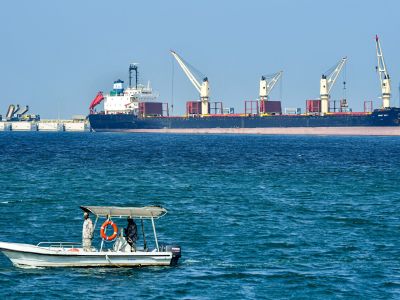
As the northernmost emirate in the UAE, RAK has a unique geographical advantage due to its location at the crossroads of one of the busiest sea and air routes in the world. Besides boasting of Mina Saqr Port and the RAK International Airport, the emirate also has a Free Trade Zone, which allows 100% ownership and 100% repatriation of capital. Being about 100 kms. away from the bustling international city of Dubai also confers the emirate with its own advantages. RAK offers a less expensive, but equally viable alternative to Dubai for business, trade and commerce. The increasing costs in Dubai may help RAK attract industries to the Emirate. Cost is a critical factor for setting up new projects. The set-up costs in RAK are relatively low. Land is almost being given for free for a period of five years, with low leasing costs thereafter. Energy costs are low and so are the living costs.
Considerable efforts are now being made to capitalize on these advantages by attracting new industries and commercial ventures, and by encouraging further development of existing industrial sectors. Priority is being given to the development of warehousing, cold storage, transport and distribution services for packing and re-export to the Gulf States, other countries in the region and to international market. Provision of maintenance support, fabrication services and other support services to the shipping sector in the UAE and the region is another focus area. The emirate is simultaneously encouraging major tourism projects that utilize the emirate’s natural resources and other picturesque locations, which make the emirate’s tourism sector a promising investment avenue. Steps have also been taken to set up a University City, to cater to the sub-continent and the Arab market. Health services is another potential investment area.
The RAK government is reported to have recently issued a freehold decree allowing foreigners and expatriates to have complete ownership of properties within RAK Properties' projects in Ras Al Khaimah. Under the royal decree, RAK Properties can sell its residential, commercial and tourism units, that are part of the company's projects, as freehold and without a time bound ownership deed. The decree is expected to give a huge boost to the economy of the emirate.
New investments worth over $1bn have been planned in RAK.
The favorable investment climate that the Emirate offers is expected to attract sizeable investments across various sectors in the days to come. RAK is expected to present a viable investment destination to potential investors not only from the Arab world but from other parts of the world too.